
Spain
Crema Catalana
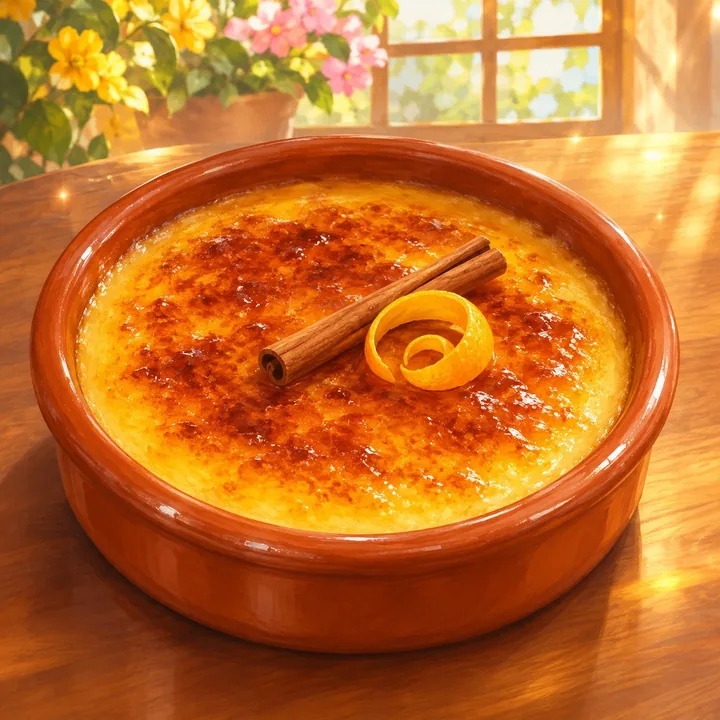
Crema catalana is a stovetop custard from Catalonia, made with milk rather than cream and scented with citrus peel and cinnamon. It's also called crema de Sant Josep, after St. Joseph's Day on March 19. Lighter than crème brûlée, it depends on a slow, patient whisk over gentle heat, because a moment of neglect at the bottom of the pan leaves you with lumps.
- Prep
- 4 hr 35 min
- Cook
- 40 min
- Total
- 5 hr 15 min
- Serves
- 6
Ingredients
 3 cups (720 ml) whole milk, divided
 3 wide strips of lemon peel, no white pith
 3 wide strips of orange peel, no white pith
 1 cinnamon stick
 6 large egg yolks
 1/2 cup (100 g) sugar, plus 6 tbsp (75 g) for the topping
 1/4 cup (30 g) cornstarch
Instructions
- Measure out 1/2 cup (120 ml) of the milk and set it aside. Put the rest in a saucepan with the lemon peel, orange peel and cinnamon. Heat gently for about 8 minutes, until steaming with small bubbles at the edge.
- Take the pan off the heat, cover and steep for 20 minutes.
- Meanwhile, whisk the yolks with the 1/2 cup (100 g) of sugar for 2 minutes, until pale. Whisk the cornstarch into the reserved cold milk until smooth, then whisk it into the yolks.
- Strain the infused milk into a clean pan and reheat for about 3 minutes, until steaming. Slowly pour about 1 cup (240 ml) of it into the yolks while whisking, then pour everything back into the pan.
- Cook over medium-low heat for 5 to 6 minutes, whisking constantly and scraping the corners, until the custard is thick and the first slow bubbles break the surface. Keep whisking for 1 minute more. This cooks out the starchy taste and takes the eggs past the safe 160°F (71°C).
- Strain through a sieve if you see any lumps. Divide among 6 shallow dishes of about 6 oz (180 ml), and smooth the tops. Cool on the counter for 20 minutes, cover loosely, and refrigerate for at least 4 hours, until cold and set.
- Just before serving, blot any moisture from the surface and sprinkle each dish with 1 tbsp of the remaining sugar in an even layer. Melt with a kitchen torch, moving constantly, until amber with a few dark spots. Wait 2 minutes for it to harden, then serve within 30 minutes.
Tips
- If the chilled custard turns runny, it probably didn't quite reach a bubble. Starch-thickened egg custards can thin out in the fridge unless they get that final minute of bubbling heat.
- No torch? Set broiler-safe dishes on a sheet pan 2 to 3 inches (5 to 8 cm) from a preheated broiler for 1 to 3 minutes, turning them as needed. The custard warms up slightly this way, so start with it very cold.
- Coarse sugar melts unevenly and burns before it melts through. Superfine sugar, or regular sugar blitzed for a few seconds in a blender, gives the thinnest and most even crust.
Did you know?
- Crema catalana is a custard from Catalonia with a crackly sugar top.
- It's flavored with citrus peel and cinnamon.
- It's traditionally served on Saint Joseph's Day in March.
Questions
What is the difference between crema catalana and crème brûlée?
Crema catalana uses milk thickened with egg yolks and cornstarch on the stove, flavored with citrus and cinnamon. Crème brûlée uses heavy cream, usually with vanilla, and is baked in a water bath.
Can I make crema catalana ahead of time?
Yes, the custard keeps, covered, for up to 2 days in the fridge. Only caramelize the sugar right before serving, because the crust softens and weeps within an hour or so.
Why did my crema catalana get lumpy?
The custard was either heated too fast or not whisked into the corners of the pan. Lower the heat and pass it through a fine sieve while it's hot, and small lumps will disappear.
 Seafood Paella
 Fideuà